
Here are some of the most common questions we get from clients and potential clients:
What is eligible SR&ED?
SR&ED is not equivalent to R&D, new project development, or innovation and usually only covers a subset of this work.
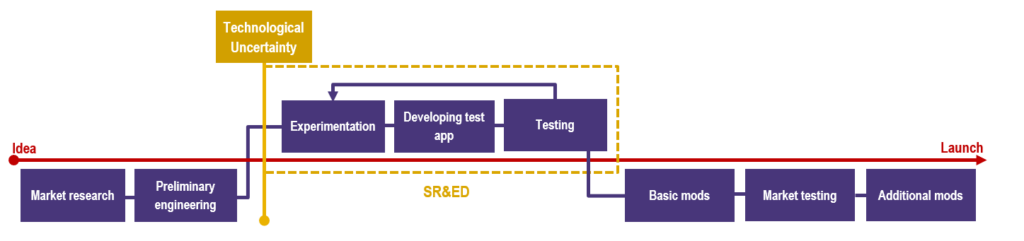
SR&ED must result in the development or understanding of new knowledge and is defined in the Income Tax Act (ITA) as “a systematic investigation or search in a field of science or technology by means of experiment or analysis” by means of:
- Basic Research,
- Applied Research, or
- Experimental Development, and includes
- Direct, commensurate support work.
Basically, to be SR&ED you have to be able to answer yes to all of CRA’s five eligibility questions for the work/costs you claim. The 5Qs are:
- Scientific or Technological Uncertainty (STU)?
- A hypothesis aimed at reducing STU?
- Was the process systematic and consistent with the scientific method?
- Was there Scientific or Technological Advancement (STA)?
- Were detailed supporting records kept?
How can I tell if I have an eligible project?
Ask yourself “are we…
- …developing something new or making incremental improvements to it (i.e. materials, devices, products, or processes)?”
- …improving functionality, quality, cost, cycle times, scrap rates, life cycles, etc. of something?”
- …better at something today than in the past?”
- …having problems making something work using existing tools and techniques?
- …learning or developing something that you would not want competitors to know about?”
If yes, the something may be the focus of an SR&ED Project!
I claimed in the past but was deemed ineligible, should I even bother trying again?
For most programs, including the SR&ED Program, each year must stand on its own. Just because your work was not eligible in a prior period does not mean that current work is ineligible too. Eligibility criteria must be met for every year claimed.
A claim can be denied for many reasons. These can include:
- not meeting one or more of the eligibility criteria for the period.
- not clearly explaining work in terms of criteria.
- not linking costs to claimed work.
- missing a deadline.
- failing to respond to auditor requests.
Often reasoning for claim failures in prior periods can help us better position your claim now. Contact us for a free consultation.
What should we expect during a claim process?
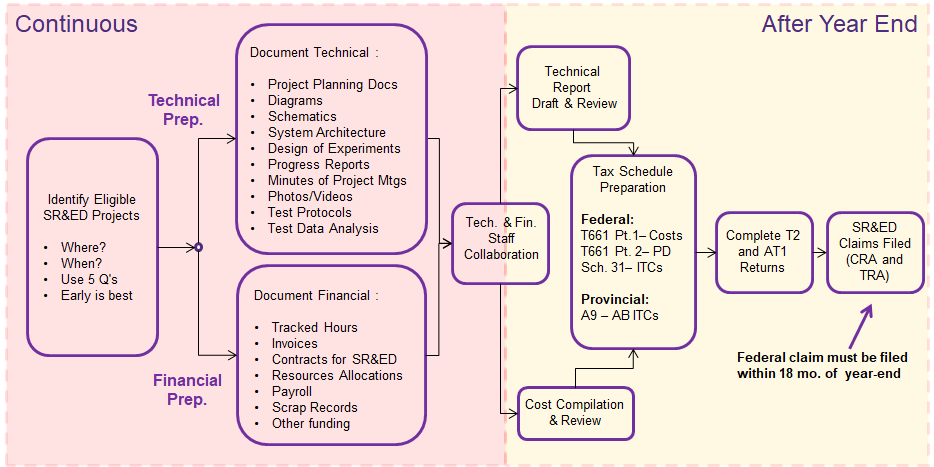
Our process has been refined over many years of preparing claims and dealing with funding program facilitators. To see what a typical engagement looks like please see the flowchart below:
What are your fees?
Or fee structure is flexible and can be customized to meet your current needs. Typically most companies do not want to bear the risk of the claim so will opt for a contingency structure, but if something more predictable is desired we can work on a fixed, hourly, daily or some other type of hybrid agreement.
Contingency rates do depend on the risk, size and complexity of each claim but typically run between 15% and 25% of the earned recovery and fees are not due until your claim is approved.